What Script Readers Look For (and the Notes I Give Most)
Adam P. · October 9, 2026 · 5 min read
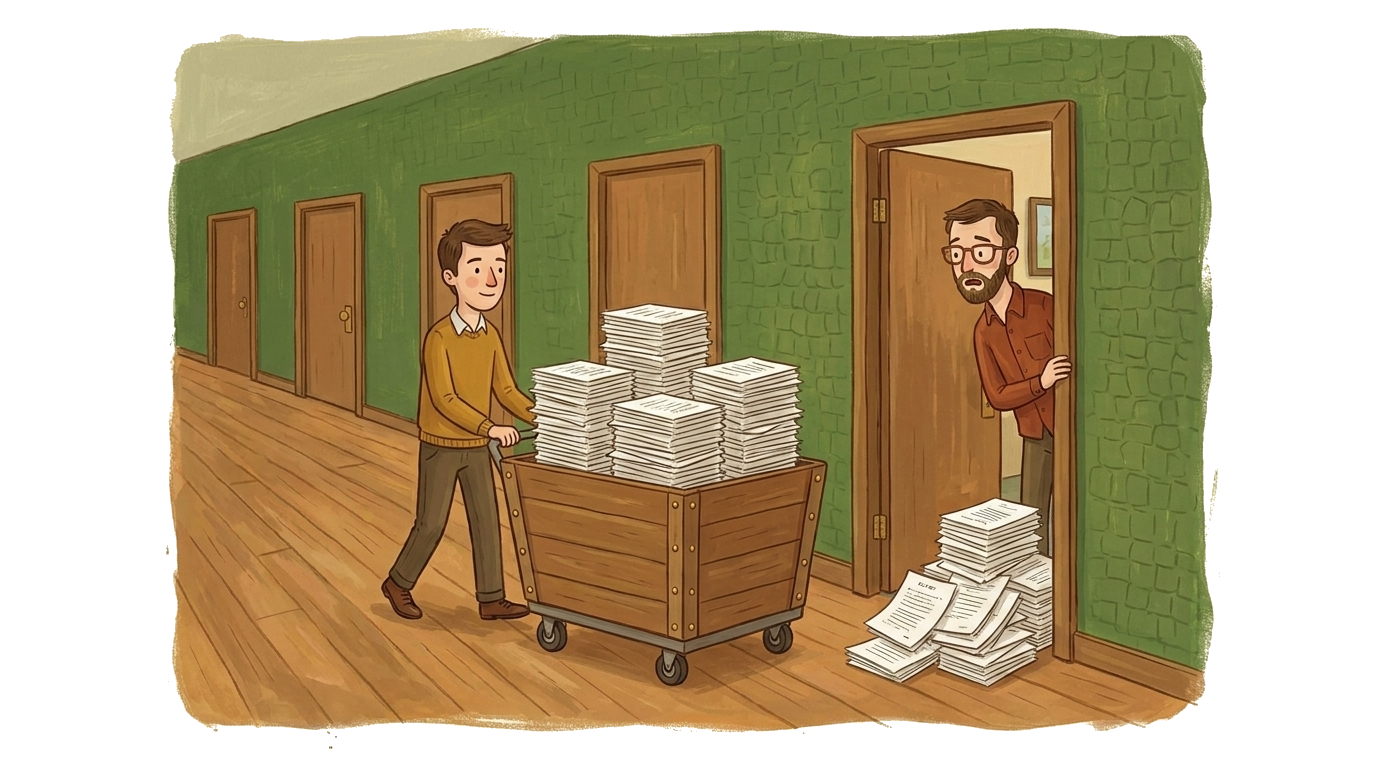
A script reader has one job: decide whether the person upstairs should spend two hours on your script. That's it. They read the whole thing, write coverage, and put a little bit of their own reputation on the line every time they say yes.
I've done a lot of this reading, at production companies, studios and management companies, and in more writers' workshops than I can count. After enough scripts, you notice that most drafts don't fail for a hundred different reasons. They fail for the same dozen, over and over. Here's what readers notice first, and the notes I find myself giving most.
What a reader notices in the first ten pages
Readers decide a lot early. Not everything, but a lot. By page ten, I want to know:
- Whose story this is. Who are we following, and why them?
- What world we're in, and what the rules are.
- What kind of movie it is. Comedy, thriller, drama. The tone you set here is a promise.
- Whether the writer can write. Clean scene description, dialogue that sounds like people, and pages that move.
That last one is bigger than writers think. Readability is king. Dense four- and five-line blocks of action, camera directions, parentheticals telling the actor how to feel, typos: none of it is fatal alone, but together they tell a reader the script is going to be work. A reader who's working is a reader who's looking for reasons to pass.
The notes I give most
These come up in script after script, from first-timers and pros alike. Each one comes with the fix.
1. "I don't know whose story this is." Sometimes the protagonist doesn't show up until page nine. Sometimes there are three characters with equal weight and no one to hold onto. A reader needs someone to follow early. If you've got an ensemble, someone still has to be the way in.
2. "The protagonist is reacting, not acting." This is the big one. Things happen to the hero, and they respond. They get chased, summoned, told, rescued. A protagonist needs a goal and makes choices in pursuit of it, and the story should change because of what they decide. Stars drive the action.
3. "The end of Act One happens to them." The act break should be a decision, not an accident. Your protagonist can be pushed to the edge, but they have to choose to jump. If the end of Act One is something that happens to them, the whole second act tends to go passive too.
4. "The second-act turn comes out of nowhere." The big turns in the back half of the script should come from inside the story, ideally from the central relationship, not from a random outside event. A car crash, a sudden illness or a phone call from a stranger can start a story. They shouldn't steer it.
5. "The antagonist disappears in Act Three." I give this note constantly. The antagonist drives the first two acts, then the climax is a car chase or a fight with somebody else. The final confrontation needs the opposition in the room. More on antagonists here.
6. "This is too convenient." The hero overhears the right conversation. A stranger hands over the key evidence. The cops arrive just in time. Bad luck is fine. Good luck is a loan the script has to pay back. Here's where coincidence works and where it doesn't.
7. "The dialogue is on the nose." Characters say exactly what they feel, in complete sentences, and explain things to each other they both already know. It makes everyone sound like they're reading their own character bios out loud. The fix is subtext.
8. "They're arguing, but nobody wants anything." A shouting match isn't conflict. Conflict is two people who want incompatible things. If you can't say what each character in a fight is trying to get, the scene is noise, however loud it is.
9. "What has she learned?" At the end, I should be able to say how the protagonist is different from who they were on page one. If I can't, the arc isn't on the page, and usually it's because the flaw was never clear in the first place. Start with the flaw.
10. "The early tone doesn't set up the later tone." A light comedy for sixty pages and then a brutal murder. A grounded drama that turns supernatural on page eighty. You can shift tone, but you have to promise it early. Otherwise the reader feels tricked rather than surprised.
11. "It feels like a movie, not a show." (Pilots only) A pilot has to show us what a normal episode looks like, not just a story with a beginning, middle and end. If I finish a pilot and can't picture episode five, the show doesn't have an engine yet.
What those notes have in common
Look at that list again. Almost none of it is about the idea. Readers aren't passing on most scripts because the concept is bad. They're passing because the protagonist isn't driving, the structure isn't built on choices, or the pages are hard to get through.
That's good news. Those are all fixable. The concept is the hard part, and you probably already have it.
A few things readers are thinking about that writers aren't
- Page count. A reader feels a 130-page script before they read a word. For a feature, somewhere around 90 to 110 pages is where most readers relax.
- Whether they can pitch it. If I can't write a clean one-sentence logline for your script, I can't sell it to my boss in the hallway either.
- Where the act breaks land. Readers read toward the turns. If the first one hasn't arrived by around page 30, they start checking the page number.
- Whether you hang a lantern. If something's strange and a character notices it, readers relax. If nobody does, readers assume you didn't notice either.
How to use notes like these
Notes are symptoms. If a reader says the second act drags, they're usually right that it drags, even if the fix is twenty pages earlier. And look for patterns. One note may just be one reader's taste. The same note from your coverage and from the people in your life who've read the draft is something to take seriously. If you want more on what to do with a report once you have it, start here.
Get the read before the reader does
Every one of these notes is something an Auteur report is built to catch, with a 20-category ratings grid and page-specific notes written the way a professional reader writes them. Send us your script and you'll have coverage back in minutes, before it lands on anybody's desk.