Subtext: How to Write Dialogue That Isn't Conversation
Adam P. · October 9, 2026 · 5 min read
Subtext is what a character means but doesn't say. The words are about one thing and the scene is about another. It's the difference between dialogue that sounds like a script and dialogue that sounds like people.
The most useful thing anyone ever told me about dialogue came from a screenwriting professor, and it's four words: dialogue is not conversation.
Real conversation is mostly filler. "How was your weekend?" "Fine, you?" Nobody buys a ticket for that. In a script, every exchange is an argument in disguise. Each character wants something from the other person, and they're dressing that want up as small talk.
Why on-the-nose dialogue kills a scene
On-the-nose dialogue is when characters say exactly what they feel. "I'm angry because you forgot my birthday, and it makes me feel like you don't value me." Nobody talks like that outside of therapy, and even there they're bad at it.
When characters announce their feelings, the actor has nothing to play and the audience has nothing to do. Half the pleasure of watching a movie is working out what people actually mean. Take that away and the scene is dead on the page.
It's also one of the things I flag most when I read. On-the-nose dialogue makes characters sound robotic, like they're reading their own character bios out loud. I've been on the other end of it too. I once got a note on a spec that a scene built on sexual tension was way too talky. Fair. Two people who want each other and can't say so is about the most subtext-rich setup there is, and I was burying it under lines.
The three levels of dialogue
I think of dialogue as working on three levels.
Level one says it. "I'm going to kill you." Clear, and the least interesting option.
Level two hints at it. "I bought a new gun this morning." The threat is there, but the listener, and the audience, has to do a little work.
Level three talks about something else entirely. The characters are discussing the weather, or a T-shirt, or a bottle of wine, and context does all the work. This is where subtext lives, and it's where the great scenes are.
The classic level-three move is the stand-in topic. A couple fights about who left the dishes in the sink, and everyone watching knows the fight is really about the marriage. The dishes are safe to fight about. The marriage isn't.
Two scenes that do it right
In Sideways, Maya asks Miles why he's so into pinot noir. His answer is all about the grape. It's thin-skinned and temperamental, it only thrives in a few tucked-away corners of the world, and only somebody patient enough to really understand it can bring out what it's capable of. He's describing himself, and he's pretty much asking her to be that person. Then Maya talks about how a wine keeps changing, how a bottle tastes different from one day to the next until it peaks and starts to decline. She's talking about being alive, and about not waiting too long. It's a love scene where nobody says a word about love.
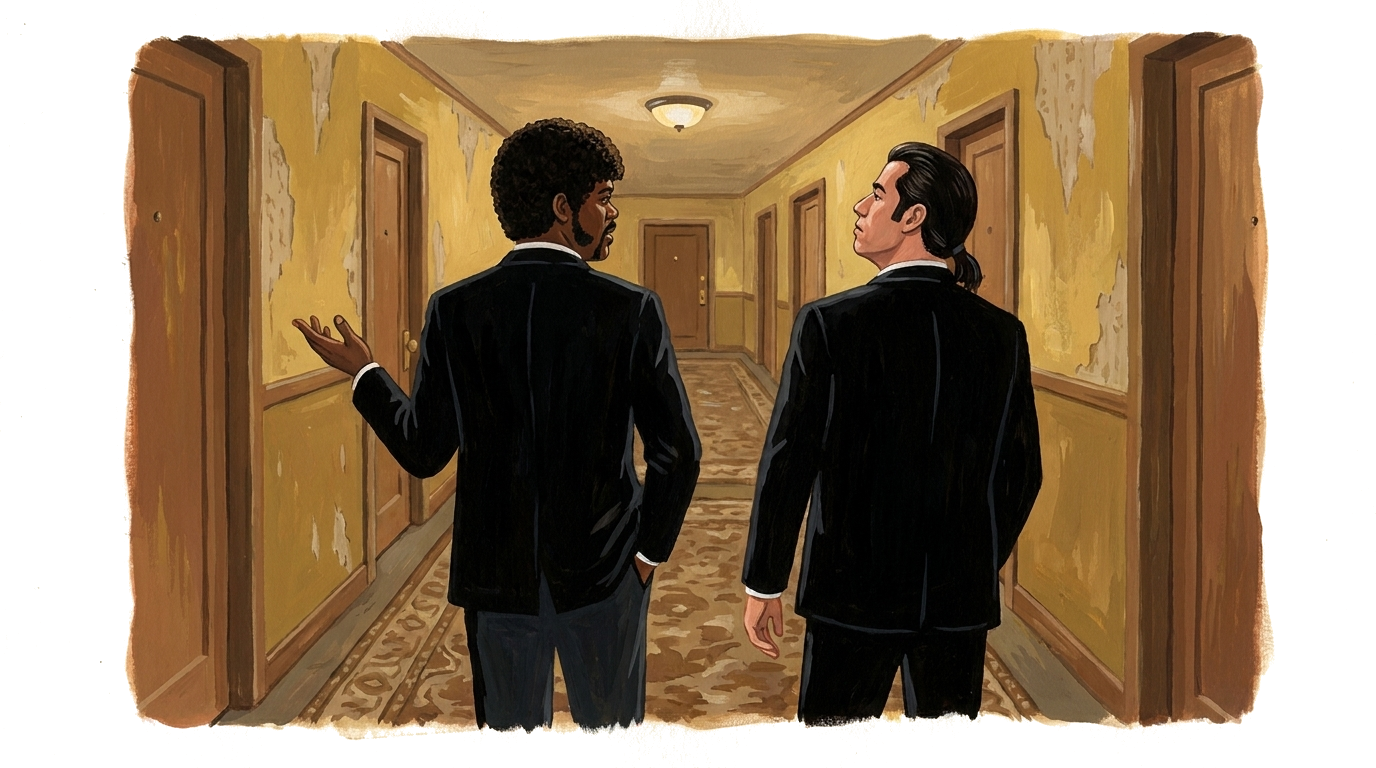
Pulp Fiction does a funnier version. On the way up to the apartment, Jules and Vincent argue about whether a foot massage means anything, because word is Marsellus had a guy thrown off a balcony for giving his wife one. On the surface it's two hitmen debating etiquette. Underneath, Vincent has just been asked to take that same wife out while Marsellus is out of town, and he's trying to work out exactly where the line is. Our Pulp Fiction coverage makes the point that none of these digressions feel like padding, because the digressions are where the relationship and the world get built.
Whoever asks the question loses the moment
A small rule that fixes a lot of scenes: try not to let your characters ask each other questions. When one character asks, the other has to answer, and the one answering usually wins the moment. Too many questions make characters sound passive and turn scenes into interviews.
Turn the question into a statement. "Are you seeing someone?" becomes "You've been getting home late." Same information, but now the character is pushing instead of asking, and the other person has to answer an accusation instead of a request.
Somebody wins, somebody loses
Every dialogue scene is a little fight, and somebody should come out ahead. If nobody wins and nobody loses, your characters are being too polite. Usually that's because you like them and you don't want them to get hurt. That's sweet, and it's fatal.
A new beat starts when the person driving the scene changes, or changes the subject. When a scene isn't working, figure out who's driving it, what they want, and the exact moment the other person grabs the wheel. And once the next step feels inevitable, cut. The audience can finish the scene in their heads.
Exposition is a weapon
The worst dialogue in most drafts is exposition: characters telling each other things they both already know so the audience can catch up. "As you know, our father died ten years ago."
Information should only come out when one character uses it to change another. A brother doesn't mention that Dad died ten years ago. He brings it up to win the fight about selling the house, and now the exposition is a punch. Hold information back as long as you can, and when it finally comes out, make somebody use it.
How I actually write it
You don't have to get subtext on the first pass. I don't.
- Write it on the nose. First draft, everybody says exactly what they mean. That's your map. Now you know what the scene is really about.
- Find what they're afraid to say. Each character is avoiding something. That fear is what makes them talk around it.
- Go sideways. Find the stand-in topic. What could they fight about instead? The dishes, the wine, the foot massage.
- Read it out loud. If you can't say a line without wincing, an actor won't be able to either.
- Try silence. Sometimes the best version of a line is no line. A look, a pause, somebody leaving the room before they answer.
Signs your dialogue is on the nose
- Characters explain their feelings in complete sentences.
- Everyone answers every question directly.
- Characters keep saying each other's names.
- People tell each other things they both already know.
- You could swap lines between two characters and nothing would change.
- Every argument is about exactly what it's about.
See how your dialogue reads
Dialogue is one of the 20 categories graded in every Auteur report, and the analysis points to the specific pages where it's working and where it's going on the nose. Send us your draft and you'll have coverage back in minutes.