Three-Act Structure, Explained
Adam P. · October 4, 2026 · 6 min read
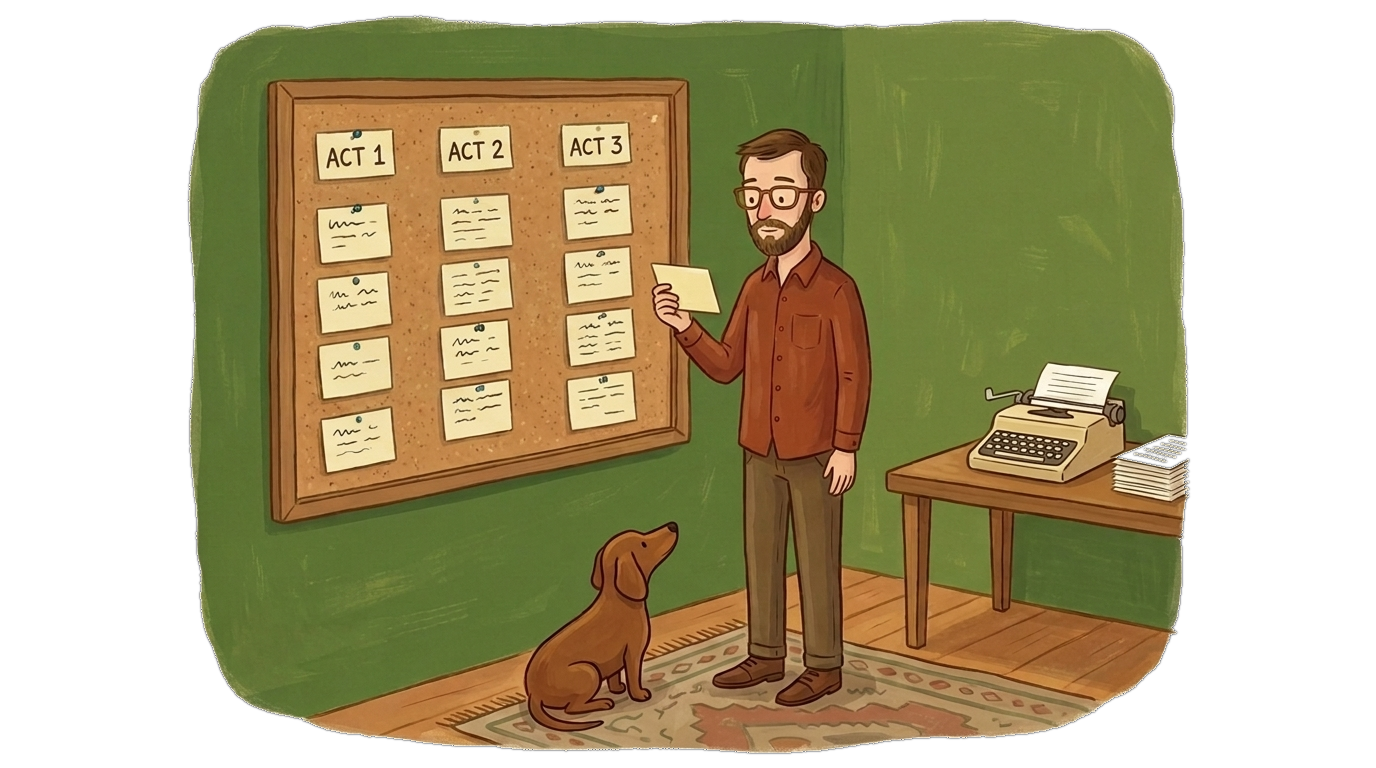
Most structure guides hand you a list of beats and page numbers and wish you luck. You end up with a script that hits page 30 on page 30 and still feels like nothing is happening, because the beats aren't connected to anything.
Here's the version I actually use. It's built on one idea, and once you've got that idea, the beats stop being a checklist and start being the shape of a story.
Your protagonist needs one clear, specific flaw. Everything they do should be an expression of that flaw. The whole movie is the story of that flaw being tested, cracked, relapsed into and finally overcome (or not). The theme of your movie is just the opposite of the flaw.
The page numbers below assume a 120-page feature. Treat them as a compass, not a contract.
Act One: the flaw and the break
The status quo (pages 1 to 10ish)
The first ten pages establish who your protagonist is, which mostly means establishing their flaw. Not telling us about it. Showing it in action, ideally in a way that's costing them something already.
In Finding Nemo, Marlin is overprotective to the point of smothering. We see it on Nemo's first day of school: the checklists, the warnings, the panic. That's the whole character in a few minutes of screen time.
The inciting incident
This is the apocalypse that shatters the protagonist's world. It doesn't have to be literal, but it has to irrevocably disrupt the status quo. There's no going back to how things were.
Nemo gets taken by a diver. Marlin's worst fear, the one his entire personality is built to prevent, just happened.
The call, the refusal, and the push
Out of the inciting incident, a potential goal rises up. The forces of the world, or another character, prompt the protagonist to go after it. That's the call to adventure.
Then there's a refusal. The protagonist hesitates, because going after the goal means acting against the flaw, and the flaw is comfortable.
Then something raises the stakes or ups the pressure so that refusing is no longer tenable. Staying put now costs more than going.
End of Act One (page 30)
The protagonist takes the first real step toward the goal and embarks on the journey. Very often it's marked by a change of location. Frodo leaves the Shire. Marlin leaves the reef for the open ocean, which for a fish like Marlin is basically leaving the planet.
Act Two: the journey and the turn
Fun and games
Now they're on the journey. They're meeting new people, learning how this new world works. This is the stretch people mean when they say "the promise of the premise," the trailer moments.
But the flaw comes along for the ride. Every new encounter brushes up against it and tests it as they chase the goal. Marlin crosses the ocean with Dory, and every time something goes wrong, he tries to control it, and every time, controlling it makes it worse.
The midpoint (page 60)
This is a drastic shift, and it's the beat most scripts fumble. The way I think about it: the midpoint is where the protagonist takes the first step toward overcoming the flaw. Up to now they've been more or less blind to their issue. Now they start to see the cost of it, or the benefit of letting it go.
It can come from a wise-wizard figure who teaches them, or grants them some power to start overcoming it. It can be the first real encounter with the villain or their foil. In Finding Nemo, it's Crush, the sea turtle, letting his kid figure things out on his own and telling Marlin, essentially, "you just know when they're ready." For the first time, Marlin sees a parent who isn't afraid. I go deeper on this in the midpoint post.
The second half of Act Two
Now the protagonist starts taking real steps toward overcoming the flaw and embodying the traits that are its opposite. They're getting better. We can feel it. Until...
End of Act Two (pages 80 to 90): the backslide
They're so close. Then new developments and new pressures overwhelm them, and they backslide into the flaw. They haven't fully learned the lesson yet, so they slip back into their old ways. And because of that, the goal now seems impossible. This is the all-is-lost moment.
The key word is because. The low point should be caused by the flaw, not by bad luck. If a meteor hits, that's a plot problem. If your protagonist blows it by doing the exact thing they've been trying to stop doing, that's a story.
Act Three: the hard lesson
The low point (page 90)
Life is shit. People have left the protagonist's side. There's no clear hope of reaching the goal. And they're embodying the flaw again, which is somehow worse than never having changed at all.
The road back
With nothing left, they can finally see what the flaw has done to their life. People abandoned them because of it. Opportunities went down the drain because of it. So they start picking up the pieces and righting the wrongs they've done. They make amends, lick their wounds, and build their strength back up until we get to...
The climax (pages 100 to 115)
The final test. The last attempt at the goal, and the toughest challenge they've faced in regard to the flaw. The flaw gets uniquely and intensely tested, and they have to use everything they've learned to slay the proverbial dragon. To win, they have to prove they've fully and truly overcome the flaw.
Ideally they get the goal, just not the way they thought they would. Or they don't get what they want, but they get what they need, the deeper emotional understanding that lets them overcome the flaw.
In Finding Nemo, the climax hinges on Marlin letting Nemo swim into danger because Nemo knows how to save Dory. The single most terrifying thing Marlin could do, he does. That's the flaw, overcome, on screen, under pressure.
The resolution (pages 115 to 120)
Tie up the loose ends and show us the character living as someone who's overcome the flaw. A new status quo. Marlin dropping Nemo at school, relaxed, joking. Same scene as the opening, different man. Fish. You know what I mean.
Why this works
When every beat is about the flaw, structure stops being arbitrary. The inciting incident matters because it attacks the flaw. The midpoint matters because it's the first crack in it. The backslide hurts because we've watched them get better. The climax lands because it's the flaw's final exam.
Look at Get Out. Chris's flaw is a specific, painful passivity: the night his mother died, he sat and watched TV. The whole script tests that passivity, and in the climax he does the thing he didn't do back then. He goes back for someone. Our coverage of Get Out digs into how Peele threads that wound through the script.
If you want the flaw and theme side of this in more depth, start with character flaw and theme.
Check your own draft
Structure problems are the hardest notes to see in your own script, because you know what you meant. Every Auteur report grades Structure, Protagonist, Stakes, Pacing and Theme in its ratings grid, and the analysis calls out specific pages where the shape is sagging. If you've got a draft that hits all the beats but still feels flat, send it to us and you'll have coverage back in minutes.